Termite tenting
Termite tenting seals your building under tarps and fills it with sulfuryl fluoride gas, which kills drywood termites in every wall, beam and attic space at once. Plan to be away for two to three nights. Xtermco has tented Oʻahu homes since 1964 under Hawaii pest control license PCO-201, and no one goes back in until every room tests at 1 ppm or less.
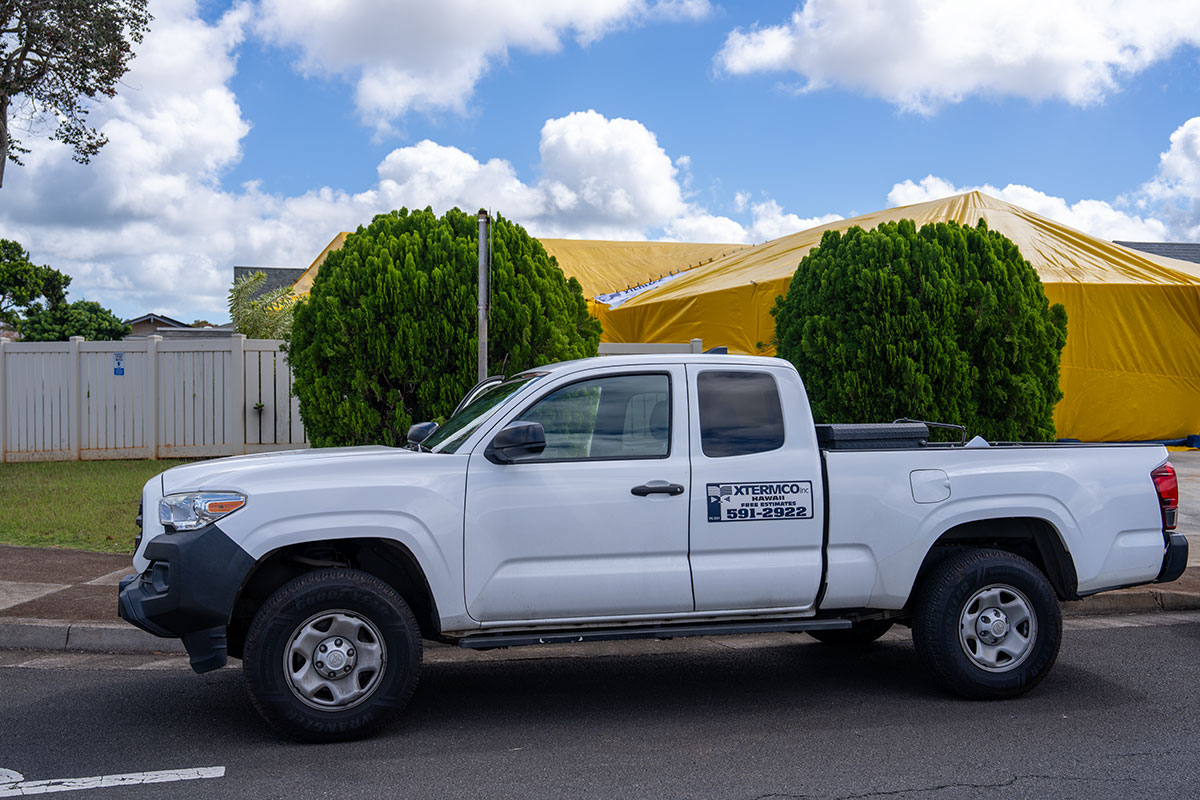
What is termite tenting, and when does a home need it?
Termite tenting, or structural fumigation, covers a building in tarps and fills it with sulfuryl fluoride gas, which kills drywood termites hidden in walls, attic framing and furniture all at once. Everyone leaves for about two to three nights, and no one goes back in until a certified applicator measures 1 ppm or less in every room.
| Termite tenting at a glance | What to know | Source |
|---|---|---|
| What it kills | Drywood termites anywhere in the building, including hidden colonies | UC IPM |
| Gas used | Sulfuryl fluoride, a restricted use pesticide, with chloropicrin released first as a warning agent | EPA |
| Time away | Usually two to three nights on Oʻahu | Xtermco |
| Before you return | Aeration, then clearance testing: 1 ppm or less in every room | Vikane label |
| Residue | None; dishes and clothes don’t need rewashing | UC IPM |
| Lasting protection | None; a yearly inspection catches new activity | UC IPM |
| Not for | Formosan subterranean termite colonies in the soil | UH CTAHR |
Tenting, or whole-structure fumigation, is the treatment for drywood termites that have spread through a building. Drywood colonies live inside the wood itself, often in several places at once: roof framing, wall studs, trim and furniture. A gas reaches all of them at the same time, including spots that can't be opened up or drilled. Not sure which termite you have? Our termite control page explains how we tell drywood and Formosan termites apart.
We usually recommend tenting when the inspection shows:
- Pellets or kick-out holes in more than one room
- Activity in the attic, walls or other spots we can't reach by hand
- Infested built-ins, cabinets or furniture
- A previous spot treatment that didn't stop the activity
If the activity is small and contained, such as one door frame, a localized treatment may be enough, and we'll say so.
Termite tenting timeline: what happens each day
Most Oʻahu tenting jobs take two to three days from the time you leave to the time you move back in. Exact times depend on the building, the dose and the weather, so we give you your move-out and return times when we schedule.
1 to 2 weeks before: Inspection, estimate and booking
We confirm drywood termites, measure the building's volume and give you a written estimate and prep list. Book a place to stay for two to three nights for everyone in the household, pets included.
The day before: Prep the house and yard
Bag or remove food and medicine, take out plants, water the soil along the foundation, unlock doors and gates, and arrange for gas service to be turned off. The full checklist is below.
Day 1: Tarps, warning signs and fumigant
The crew covers the building with tarps and seals the bottom edges to the ground with soil, sand or weighted “snakes” (Vikane label). No-entry warning signs go up and entrances are locked (EPA). A warning agent, chloropicrin, is released first, then the fumigant (EPA).
Day 1 into Day 2: Exposure
The tent stays sealed while the gas moves through walls, framing and furniture. The dose and time are calculated from the building's volume, the temperature and the target pest (Vikane label). University of California entomologists note that a monitored fumigation, with gas lines measuring the concentration inside, has the highest success rate (UC IPM).
Day 2: Aeration
Tarps come off, windows and doors are opened, and fans run for at least 2 hours. The building then stays posted and locked: re-entry waits at least 12 hours from the start of aeration, or 14 to 24 hours under the label's dose-based procedure (Vikane label).
Day 2 or 3: Clearance and move back in
A certified applicator measures the air in the breathing zone of every room with a clearance device from EPA's list. Only at 1 ppm or less can you go back in (Vikane label). Sulfuryl fluoride leaves no residue, so there's no need to rewash dishes or wipe counters (UC IPM). Turn the gas back on and relight pilots.
How do you prepare for termite tenting?
We send a written prep list before every job. These are the main points, most of them straight from the fumigant label (Vikane label).
Inside the house
- Everyone leaves, including all pets, and houseplants come out. Ask us how to handle fish tanks.
- Food, pet food, medicine and vitamins can stay only in plastic, glass or metal containers with the factory seal intact. Remove everything else or double-bag it in Nylofume bags.
- Mattresses and pillows in waterproof covers: remove the cover or open its seal.
- Put out every flame, including pilot lights on the water heater, range and dryer, and unplug heating elements.
- Open interior doors, cabinets, drawers, closets and the attic access so the gas spreads evenly.
- Raise or take down blinds and curtains if your prep list asks you to.
Outside and on the day
- Water the soil next to the foundation the day before. Moist soil helps keep the gas in and protects yard plants.
- Cut plants back 12 to 18 inches from the walls and move potted plants and vehicles away from the house.
- Unlock all doors, gates, sheds and outbuildings for the crew.
- Schedule your gas shutoff and restart with your gas provider.
- Tell us about solar panels, rooftop equipment, fragile roofing or irrigation heads before tenting day.
Tip: book your stay before you confirm the tenting date, and bag food a day early. Last-minute packing is where most prep mistakes happen.
How much does termite tenting cost on Oʻahu?
Termite tenting is priced per building, mainly by its volume in cubic feet, because the fumigant dose is set per thousand cubic feet. Xtermco inspects for free and gives you a written price before you book.
These are the things that move the price up or down:
Size and volume of the building
The fumigant dose is set per thousand cubic feet of space (Vikane label), so a larger or taller building needs more gas, more tarps and more crew time.
Roof type
Tarps are pulled across the roof, and UC IPM notes roofs can be damaged by tarps or foot traffic. Tile, steep or fragile roofs take extra padding and care.
Solar panels and rooftop equipment
Panels, water heaters and antennas have to be covered and worked around without damage, which adds time to tarping.
Lanais, garages and add-ons
Enclosed lanais, attached garages and additions are part of the space we seal and fumigate, so they add volume.
Access and tight lots
Close fences, walls, neighboring buildings and dense landscaping make it harder to tarp and seal the building at ground level.
Extra structures and treatments
Sheds, cottages or a Sentricon system for ground termites are priced on top of the main building.
When you compare quotes, ask whether the price includes a monitored fumigation, which UC IPM says has the highest success rate, aeration and clearance testing of every room, Nylofume bags, and any warranty. For more on pricing, read what affects pest control costs in Hawaiʻi.
Is termite fumigation safe for your family and home?
Sulfuryl fluoride is the only fumigant registered for use in homes. It's a restricted use pesticide, so only certified applicators, or people under their direct supervision, can use it (EPA). It's highly toxic while it's in the building, which is why the whole process is built around keeping everyone out until it's gone.
- Warning agent. The gas has no smell, so chloropicrin, which stings the eyes, is released first as a warning (EPA).
- Posted and locked. No-entry warning signs stay up from tenting through aeration, and entrances are locked (EPA, UH fumigation study guide).
- Aeration. Fans run for at least 2 hours, then the building stays closed for at least 12 hours, or 14 to 24 hours depending on the dose (Vikane label).
- Clearance testing. A certified applicator tests every room with a clearance device from EPA's list. No one goes back in above 1 ppm (Vikane label).
- Newer label rules. Since 2024, labels require longer aeration times, site-specific fumigation logs and extra applicator training for homes (EPA).
- Licensed in Hawaiʻi. The Hawaiʻi Department of Agriculture certifies fumigation applicators (UH CTAHR), and state rules treat structural fumigation as its own license branch, Branch 1 (HAR §16-94-17).
Pets and plants stay out until clearance, and sulfuryl fluoride leaves no residue on surfaces (UC IPM). Your crew walks you through the precautions for your building before work starts.
Tenting vs Sentricon vs spot treatment
Each one treats a different termite problem. Many Oʻahu homes need more than one: tenting for drywood termites in the roof and walls, and Sentricon for Formosan termites coming up from the ground.
| Tent fumigation | Sentricon baiting | Spot (localized) treatment | |
|---|---|---|---|
| Termite it treats | Drywood termites anywhere in the building | Subterranean termites, including Formosan, coming from the soil | Drywood termites in a known, reachable spot |
| How it works | Sealed tent filled with sulfuryl fluoride gas | Bait stations in the ground around the home; termites share the bait until the colony dies (Corteva) | Insecticide foam, liquid or dust put into the infested wood, or heat or other non-chemical methods (UC IPM) |
| Hidden colonies | Treats all infestations at once, even ones you can't see (UC IPM) | Reaches the colony in the soil through shared bait (Corteva) | Only the colonies that are found and treated (UC IPM) |
| Time away from home | Several days (UC IPM); usually two to three nights | None; the stations are outside | Usually none |
| Lasting protection | None; it leaves no residual effect (UC IPM) | Yes, while the stations are serviced every year (Corteva) | Only in the treated wood |
| Best for | Widespread or hard-to-reach drywood infestations | Formosan termites and homes that want yearly monitoring | One door frame, window or piece of furniture |
Sources: UC IPM, Corteva. Read more about Sentricon termite baiting on Oʻahu, or compare every option in our termite treatment comparison.
What does tenting not do?
No lasting protection
Fumigation kills the drywood termites in the building when it's treated, but it has no residual effect (UC IPM). New swarmers can start colonies later, so a yearly termite inspection is still worth booking.
Doesn't treat the soil
Formosan subterranean termites nest in the ground and build mud tubes into buildings (UH CTAHR). Tenting treats the structure, not the soil, so it won't remove an underground colony. For that, we set Sentricon bait stations around the house.
Can you fumigate boats, sheds and containers?
Yes. If a structure can be covered and sealed, it can usually be fumigated. Xtermco tents boats, storage sheds and shipping containers with the same inspection, sealing, clearance and release steps we use for homes. The dose is still set by the space being treated, so a shed or container is measured just like a house.
Boats bring their own prep: fuel, food and anything that can't be sealed, plus where the vessel sits during treatment. Read more about tent fumigation for boats, or call us to talk through a shed, cottage or container.
Why choose Xtermco for termite tenting on Oʻahu?
- Tenting since 1964. Xtermco started in 1961 and added tent fumigation and termite treatment in 1964.
- Licensed. Hawaii pest control operator license PCO-201.
- Our own crews. Locally owned, not part of a national chain. Every job is done by Xtermco’s licensed Oʻahu technicians, who go through pre-employment and quarterly drug testing.
- Local crew based in Waipahu, tenting homes, condos and commercial buildings in Honolulu, Pearl City, Kapolei, ʻEwa, Mililani, Kailua, Kāneʻohe and across Oʻahu.
- The full termite picture. Tenting, Sentricon, soil and localized treatments, plus inspections and TIRs, so the recommendation fits your termite.
Termite tenting FAQs
How much does termite tenting cost on Oʻahu?
Tenting is priced per building, not at a flat rate. The biggest factor is the building's volume, because the fumigant dose is set per thousand cubic feet. Roof type, solar panels, lanais, attached garages, tight lots and extra structures also change the price. Xtermco inspects for free and gives you a written estimate before you book.
How do I prepare my home for termite tenting?
Everyone and all pets leave, and houseplants come out. Unsealed food, pet food and medicine are removed or double-bagged in Nylofume bags, pilot lights are turned off, and interior doors, cabinets and drawers are opened. Outside, water the soil along the foundation, cut plants back from the walls and unlock every door and gate. We send a written prep list before every job.
How long do I have to stay out of my house?
Plan on two to three nights for most Oʻahu homes. After the exposure period, the building is aerated with fans for at least 2 hours and then stays closed for at least 12 hours, or 14 to 24 hours depending on the dose. You can go back in only after a certified applicator measures 1 ppm or less in every room. We give you your move-out and return times when we schedule.
Does termite tenting actually work?
Yes, for drywood termites, when it's done correctly. University of California entomologists say sulfuryl fluoride treats every infestation in the building at once and kills drywood termites within several days, and that a monitored fumigation, with gas lines measuring the concentration inside, has the highest success rate. It doesn't kill termite colonies in the soil or prevent new infestations.
Is termite fumigation safe in Hawaii?
Yes, when it's done by the label. Sulfuryl fluoride is a restricted use pesticide, so only certified applicators can use it, and Hawaiʻi certifies fumigators through the Department of Agriculture. A warning agent goes in before the gas, the tent is posted and locked, and a certified applicator must measure 1 ppm or less in every room before anyone returns. It leaves no residue.
Do I need to remove food and medicine before tenting?
Some of it. Food, feed, medicine and vitamins can stay only in plastic, glass or metal containers with the manufacturer's seal intact. Everything else, including opened packages and anything in the fridge or freezer that isn't sealed that way, is removed or double-bagged in Nylofume bags, as the fumigant label requires. Your written prep list covers each room.
Do you have to wash clothes and dishes after tenting?
No. Sulfuryl fluoride is a gas that leaves no residue, according to University of California entomologists, so clothes, bedding, dishes and counters don't need to be rewashed after clearance. Food and medicine still have to be sealed, bagged or removed before tenting, as your prep list explains.
Will tenting kill Formosan subterranean termites?
Not the colony. Formosan subterranean termites nest in the soil and build mud tubes into buildings, and fumigation treats the building, not the ground. An underground colony survives tenting and can keep sending termites into the house. For Formosan termites we use Sentricon baiting or a soil treatment, sometimes alongside tenting.
What happens to my plants during tenting?
Houseplants and any plants you want to keep must come out of the building first, as the label requires. For yard plants, water the soil along the foundation the day before: the label notes moist soil reduces gas escape and plant injury. Cut plants back from the walls so tarps and sand snakes don't crush them.
Does tenting stop termites from coming back?
No. Fumigation kills the drywood termites in the building when it's treated, but it has no residual effect, so new swarmers can start colonies later. A yearly termite inspection catches new activity early. If your property also has Formosan subterranean termites, Sentricon stations give ongoing protection from the soil side.
Questions to ask before scheduling termite fumigation
Before you book any tenting company, get clear answers to these:
- Which termite did the inspection find, and where? Tenting is for drywood termites; Formosan termites in the soil need a different treatment.
- Why is tenting the right fit, rather than a spot treatment?
- Is the fumigation monitored, with gas lines measuring the concentration inside? (UC IPM says monitored fumigations have the highest success rate.)
- What does the written estimate include: tarps, Nylofume bags, aeration and clearance testing of every room?
- When do we move out, and when can we come back in?
- What follow-up do you recommend, such as a yearly inspection?
Your property-specific prep list comes from the fumigation team, so confirm the details for your home, pets and access with them directly. For background on clearance testing, see the EPA explanation of fumigation clearance devices.
Book a free tenting inspection
Found pellets or kick-out holes in more than one room? We'll inspect, confirm the termite and give you a written estimate and prep list at no charge.
